One-sentence problem: Do Formula 1 rookies improve over their debut season — and does being paired with a superstar teammate help them or quietly crush them?
The question
Every F1 team faces the same talent-development bet: how do you bring a rookie along? One popular theory says pairing a young driver with an elite veteran accelerates their growth. The opposite theory says it creates a “pressure cooker” that stifles them. I wanted to test which one the data actually supports.
I built a rookie performance score from three inputs — starting grid, net positions gained, and finish position — for 70 true rookies with complete debut seasons (2004–2024), split each season into halves to measure improvement, and grouped rookies by the caliber of their veteran teammate.
The pattern
- Most rookies improve. 58% posted a better score in the second half of their debut season than the first.
- Starting strong is a trap. Rookies who began below the midpoint improved 63.6% of the time; those who started above it improved only 36.4% — early success is hard to build on.
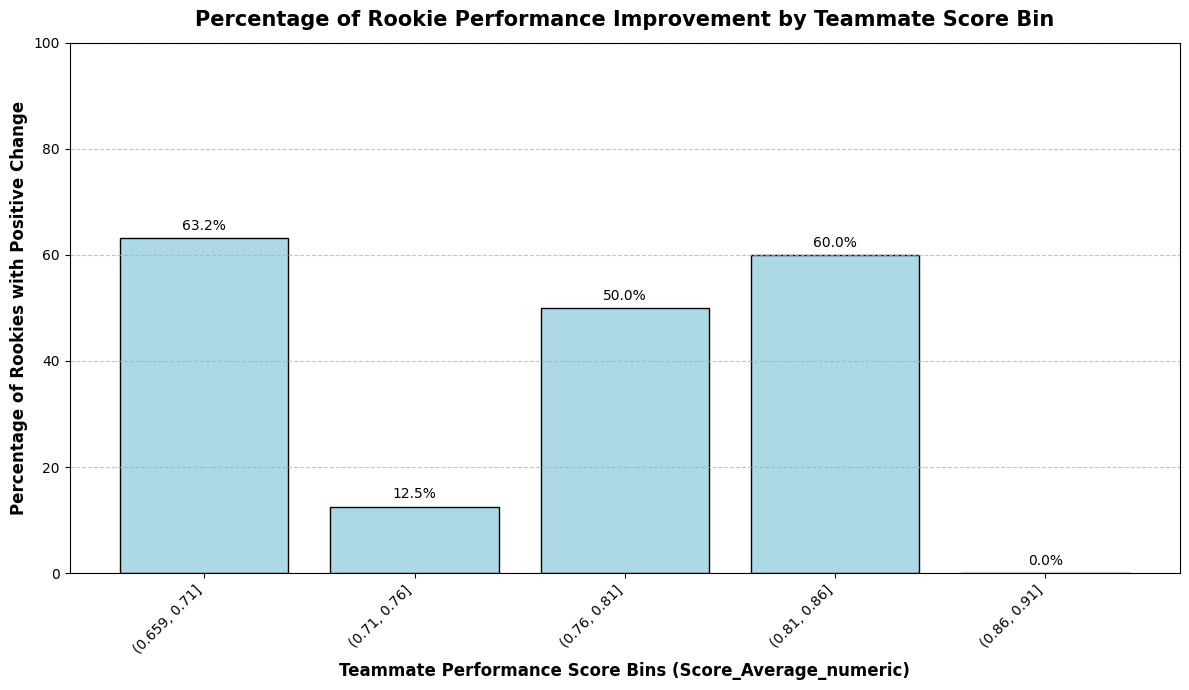
- The “pressure cooker” is real — at the extremes. Rookies paired with the strongest teammates (top score bin) showed 0% positive improvement, while those paired with the weakest teammates improved over 60% of the time.
So what?
For a team making talent-development decisions, this reframes a common assumption. The instinct to pair a promising rookie with your biggest star — to “let them learn from the best” — may actually suppress the rookie’s visible development, at least in a debut season. The data suggests a rookie’s improvement is shaped as much by their environment as by their raw ability: put them next to an unbeatable benchmark and their measurable progress stalls; give them room against a weaker teammate and they climb.
The practical read for a team strategist: how you pair and sequence a young driver isn’t neutral — it’s a lever. A development-focused season might deliberately avoid the superstar pairing until the rookie has footing.
The honest caveat: this is a small sample (70 rookies), and the most extreme teammate bins contain only a handful of drivers each — so the 0% and 60%+ figures are suggestive signals, not settled laws. The direction of the effect is consistent and interesting; the exact magnitudes would need a larger sample to pin down. I’d treat this as a hypothesis worth testing further, not a rule to build a season around.
 Rookie improvement rate by teammate caliber. Improvement is highest against weaker teammates and collapses to zero against the very strongest — the “pressure cooker” effect.
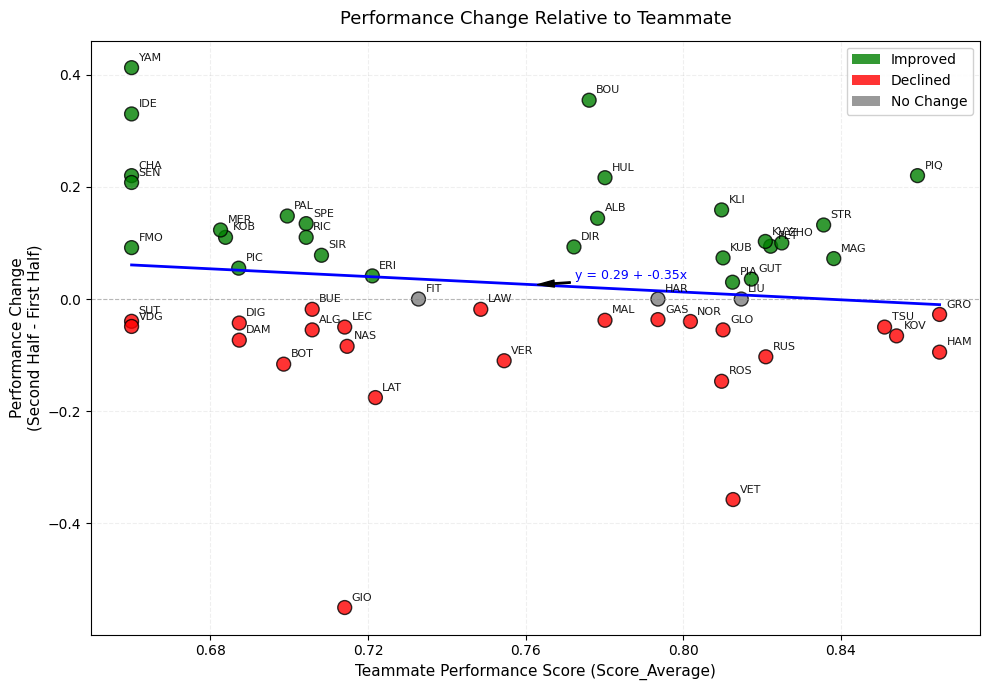 Each point is a rookie. The downward trend line shows performance change falling as teammate strength rises.
How I did it
Data cleaning and the performance-score construction were done in Microsoft Excel; visualization in Python. Source: Formula 1 race data (1950–2024), filtered to 70 true rookies from 2004–2024 to control for era differences in season length and mid-season driver swaps.
Dig deeper
Course project, Sport Management, UMass Amherst. Data source: Formula 1 Racing (1950–2024) via Kaggle.